JWST maps the weather on a hot gas giant 700 light-years away
The differences seen here could be throwing off how we study planetary atmospheres.
Signal weather
Rising
Momentum is building quickly, so this card is a good early entry point into the topic.
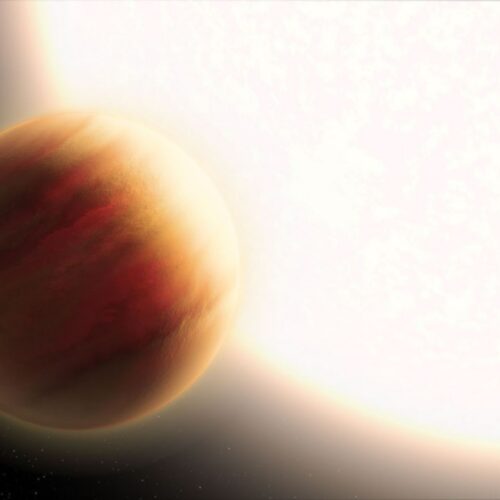
WASP-94A b is a hot, tidally locked gas giant orbiting close to one of the stars in a binary system roughly 690 light-years away from Earth. In a new Science study, scientists led by Sagnick Mukherjee, an astrophysicist at Johns Hopkins University, used the James Webb Space Telescope to learn what the weather looks like out there. Tidal locking means that you no longer have day- and night-side temperature differences sweeping across the planet. “We wanted to understand the atmospheres of such planets,” Mukherjee says. “Are they static or dynamic? Do they have winds? Do they have clouds?” His team found that, on WASP-94A b, it’s cloudy in the morning, but the skies clear in the evening. The fact that we didn’t know this already means we might have gotten the chemistry of this and many other exoplanets surprisingly wrong. Averaged atmospheres WASP-94A b has mass slightly below half of Jupiter but has a diameter that’s over 70 percent wider. “This means the planet has low density, and its atmosphere extends further out into space, which makes it easier to observe,” Mukherjee explains. When astronomers study atmospheres like this, they usually rely on transmission spectroscopy. By analyzing the spectrum of light filtering through the planet’s atmosphere as it crosses in front of its star, they can figure out its chemical composition. Read full article Comments
Stay on the signal
Follow JWST maps the weather on a hot gas giant 700 light-years away
Follow this story beyond a single article: new follow-ups, adjacent sources, and the evolving storyline.
Story map
Understand this topic fast
A quick entry into the story: why it matters now, who is involved, and where to go next for context.
Why it matters now
Topic constellation
Open the live map for this story
See which entities, story threads, sources, and follow-up articles shape this story right now.
Click nodes to continue
Entity pages
Story timeline
Continue with this story
A short sequence of events and follow-up stories to understand the arc quickly.
How reliable this looks
Signal and trust for Ars Technica
This source works at a rapid pace: 100% of recent stories land in the hot window, and 0% carry visible search signal.
Reliability
92
Freshness
100
Sources in storyline
1
Related articles
More stories that share tags, source, or category context.

Zillow loses thousands of listings in fight over “hidden” homes
Zillow asked for a preliminary injunction as real estate industry fight heats up.
Signal weather
Momentum is building quickly, so this card is a good early entry point into the topic.
Why now
Fresh coverage with immediate momentum.

Stunning aerial footage still best thing about Top Gun at 40
Tony Scott's 1986 blockbuster and the 2022 sequel are the best recruitment tools the US Navy could hope for.
Signal weather
Momentum is building quickly, so this card is a good early entry point into the topic.
Why now
Fresh coverage with immediate momentum.
Uh-oh, the International Space Station is leaking again
"This further confirms the wisdom of the current policy of retiring the ISS in 2030."
Signal weather
Momentum is building quickly, so this card is a good early entry point into the topic.
Why now
Fresh coverage with immediate momentum.
US government takes $2 billion equity stake in nine quantum computing firms
Beneficiaries include startup backed by firm with links to the Trump family.
Signal weather
Momentum is building quickly, so this card is a good early entry point into the topic.
Why now
Fresh coverage with immediate momentum.
More from Ars Technica
Fresh reporting and follow-up coverage from the same newsroom.
Zillow loses thousands of listings in fight over “hidden” homes
Zillow asked for a preliminary injunction as real estate industry fight heats up.
Signal weather
Momentum is building quickly, so this card is a good early entry point into the topic.
Why now
Fresh coverage with immediate momentum.
Stunning aerial footage still best thing about Top Gun at 40
Tony Scott's 1986 blockbuster and the 2022 sequel are the best recruitment tools the US Navy could hope for.
Signal weather
Momentum is building quickly, so this card is a good early entry point into the topic.
Why now
Fresh coverage with immediate momentum.
Uh-oh, the International Space Station is leaking again
"This further confirms the wisdom of the current policy of retiring the ISS in 2030."
Signal weather
Momentum is building quickly, so this card is a good early entry point into the topic.
Why now
Fresh coverage with immediate momentum.
US government takes $2 billion equity stake in nine quantum computing firms
Beneficiaries include startup backed by firm with links to the Trump family.
Signal weather
Momentum is building quickly, so this card is a good early entry point into the topic.
Why now
Fresh coverage with immediate momentum.