Your empty cuppa could capture carbon
Polystyrene can be upcycled into carbon sponge material.
Signal weather
Rising
Momentum is building quickly, so this card is a good early entry point into the topic.
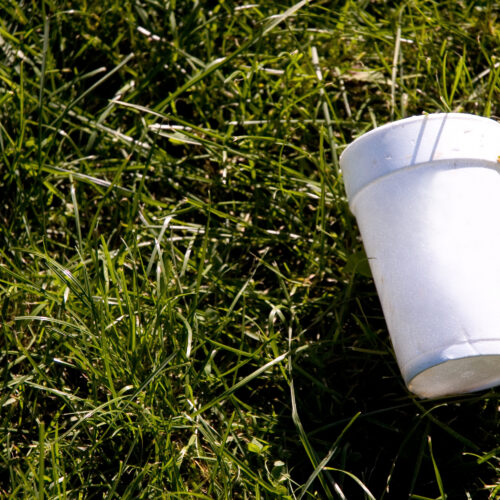
Humanity has littered the sky with the refuse of fossil fuel use, releasing enough CO2 to change the planet’s climate. We are also chucking incredible sums of carbon in the form of plastics into landfills and into the environment around (and inside of) us. What if cleaning up one of these problems could also help clean up the other? A new study led by Ruth Ebenbauer at Aarhus University experiments with this idea by upcycling discarded polystyrene into (part of) a material commonly used in carbon-capture systems. Adding amines This material is based on amines—a simple chemical group that conveniently acts like a sponge for CO2. An amine will grab CO2 molecules when exposed to them, but let go of the CO2 when heated or depressurized, leaving it ready to go again. The first “CO2 scrubbers” tried in smokestacks used amines dissolved in water to do this, but solid amines are used in all kinds of carbon-capture systems now because they require less energy. These solid materials—often made into granules similar to the activated carbon in a water filter—have high surface area and high porosity, so the amines can efficiently partner up with CO2 molecules. Read full article Comments
Stay on the signal
Follow Your empty cuppa could capture carbon
Follow this story beyond a single article: new follow-ups, adjacent sources, and the evolving storyline.
Story map
Understand this topic fast
A quick entry into the story: why it matters now, who is involved, and where to go next for context.
Why it matters now
Topic constellation
Open the live map for this story
See which entities, story threads, sources, and follow-up articles shape this story right now.
Click nodes to continue
Story timeline
Continue with this story
A short sequence of events and follow-up stories to understand the arc quickly.
How reliable this looks
Signal and trust for Ars Technica
This source works at a rapid pace: 100% of recent stories land in the hot window, and 0% carry visible search signal.
Reliability
92
Freshness
100
Sources in storyline
1
Related articles
More stories that share tags, source, or category context.
Artemis II crew flew fast, earned new patch: Astronauts' Mach 39 emblem
"It is actually challenging how you measure [Mach] from space."
Signal weather
Momentum is building quickly, so this card is a good early entry point into the topic.
Why now
Fresh coverage with immediate momentum.
Say hi to "Siri AI"—Apple announces new, more "conversational" voice assistant
New features coming this fall alongside two-tiered, Google-powered AI model overhaul.
Signal weather
Momentum is building quickly, so this card is a good early entry point into the topic.
Why now
Fresh coverage with immediate momentum.

Gemini 3.5 and Antigravity come to Google NotebookLM
NotebookLM is getting a big upgrade, but it's only for AI Ultra and enterprise accounts right now.
Signal weather
Momentum is building quickly, so this card is a good early entry point into the topic.
Why now
Fresh coverage with immediate momentum.

For the 2nd time in weeks, Microsoft packages laced with credential stealer
73 packages run self-replicating stealer as soon as they're opened by an AI agent.
Signal weather
Momentum is building quickly, so this card is a good early entry point into the topic.
Why now
Fresh coverage with immediate momentum.
More from Ars Technica
Fresh reporting and follow-up coverage from the same newsroom.
Artemis II crew flew fast, earned new patch: Astronauts' Mach 39 emblem
"It is actually challenging how you measure [Mach] from space."
Signal weather
Momentum is building quickly, so this card is a good early entry point into the topic.
Why now
Fresh coverage with immediate momentum.
Say hi to "Siri AI"—Apple announces new, more "conversational" voice assistant
New features coming this fall alongside two-tiered, Google-powered AI model overhaul.
Signal weather
Momentum is building quickly, so this card is a good early entry point into the topic.
Why now
Fresh coverage with immediate momentum.
Gemini 3.5 and Antigravity come to Google NotebookLM
NotebookLM is getting a big upgrade, but it's only for AI Ultra and enterprise accounts right now.
Signal weather
Momentum is building quickly, so this card is a good early entry point into the topic.
Why now
Fresh coverage with immediate momentum.
For the 2nd time in weeks, Microsoft packages laced with credential stealer
73 packages run self-replicating stealer as soon as they're opened by an AI agent.
Signal weather
Momentum is building quickly, so this card is a good early entry point into the topic.
Why now
Fresh coverage with immediate momentum.